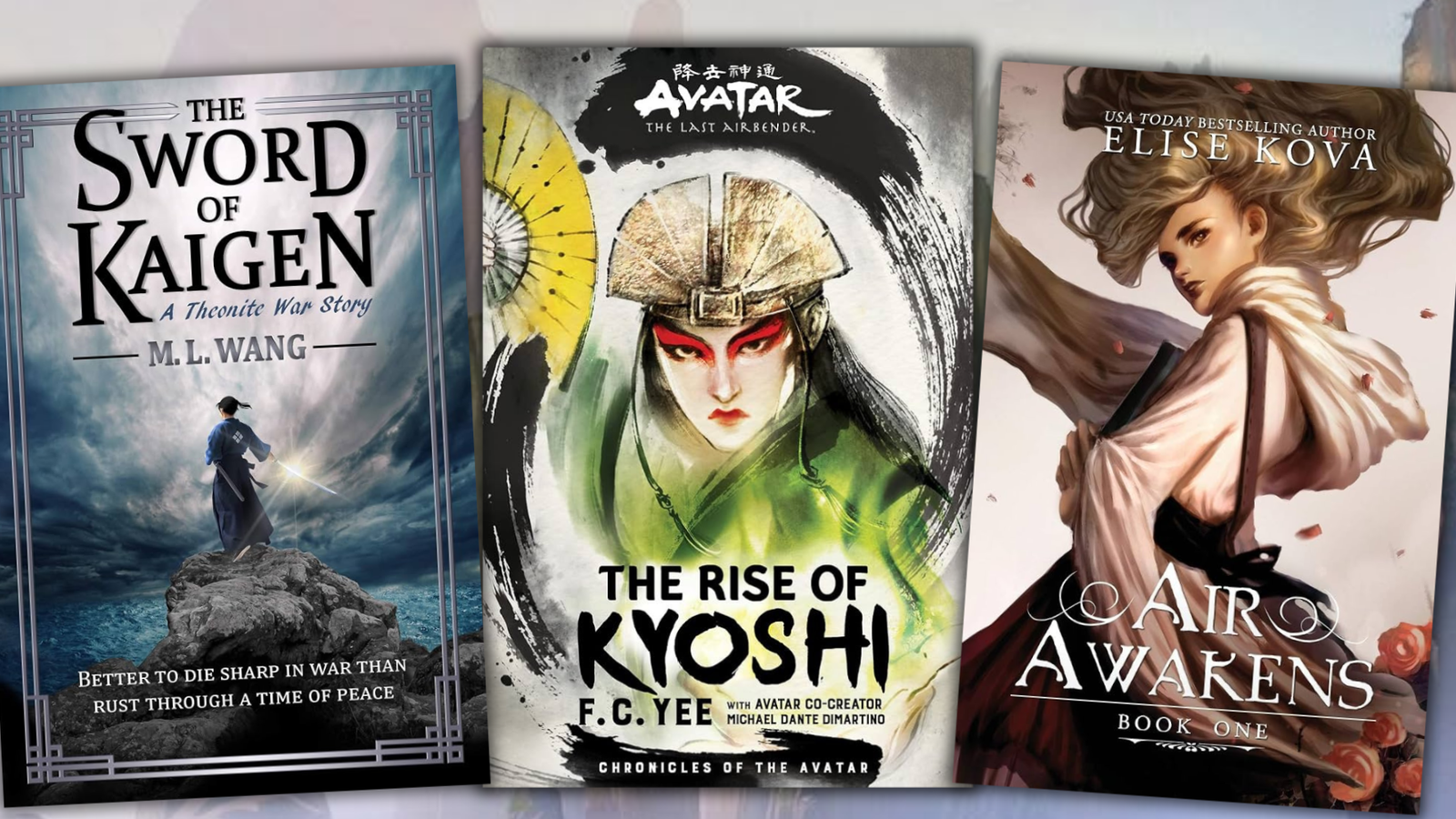
Published Aug 16, 2026, 11:00 AM EDT Hannah is a senior writer and self-publisher at ScreenRant. There, she focuses on writing news, features, and list-style articles about all things comics, books, anime, and manga. She works as a freelance writer in the entertainment industry, focusing on video games, anime, and literature. Her published works can be found on Screen Rant, FinanceBuzz, She Reads, and She Writes. If what you loved most about Avatar: The Last Airbender was watching characters turn elemental abilities into an actual martial art, there is plenty of fantasy beyond the Four Nations worth exploring. The best elemental magic systems do more than let characters throw fireballs or summon storms. They connect supernatural abilities to culture, politics, identity, combat, and sometimes even the natural laws of their worlds. The following books offer some of the closest experiences for readers who want magic with clearly defined rules and elemental foundations. Some use familiar fire, water, earth, and air, while others take the concept in stranger directions, including blood-based magic, seismic manipulation, elemental blessings, and water techniques capable of creating ice weapons. These ten books should appeal particularly strongly to anyone still looking for their next ATLA-style magic fix. 10 Truthwitch by Susan Dennard Susan Dennard's Truthwitch, the first novel in the Witchlands series, approaches elemental magic through a broader system of magical specialties called witcheries. Safiya is a Truthwitch who can distinguish truth from lies, while her best friend Iseult is a Threadwitch capable of perceiving the invisible connections between people. Prince Merik is a Windwitch, giving the story an especially strong elemental connection for ATLA fans. The appeal comes from how magic affects society rather than functioning as a simple collection of combat tricks. Different witcheries determine people's roles and political value, while Safiya's rare ability makes her a target for competing powers. The presence of wind magic alongside other specialized abilities gives the world the same satisfying sense that powers are tied to identity and social structure. 9 Servant Mage by Kate Elliott Kate Elliott's Servant Mage centers on Fellian, an indentured Lamplighter whose magic allows her to create illumination. What begins as a relatively humble magical ability becomes much more important when rebels free Fellian and involve her in a dangerous conspiracy surrounding the royal family. The novel deliberately places a seemingly modest magical talent inside a much larger political struggle. Fellian's abilities are not presented as limitless superpowers, which makes the magic feel grounded. Her connection to fire and illumination recalls one of Avatar's most appealing ideas, that elemental abilities are useful in ordinary life as well as spectacular battles. Elliott also uses magic to explore class, political control, and freedom, giving the system consequences beyond flashy action scenes. 8 The Final Strife by Saara El-Arifi Saara El-Arifi's The Final Strife takes the concept of elemental control somewhere much darker. The Empire divides its population according to blood color: red-blooded Embers occupy the ruling class, blue-blooded Dusters form the working class, and clear-blooded Ghostings are enslaved. Red blood is particularly important because Embers use it to create magical runes. That blood-based magic makes this a particularly interesting recommendation for fans intrigued by Avatar's more dangerous bending techniques. Rather than manipulating water or fire directly, characters weaponize their own blood through a system built into the Empire's social hierarchy. The result is a magic system where power, oppression, and physical sacrifice are inseparable, giving every supernatural ability political weight. 7 Troubled Waters by Sharon Shinn Troubled Waters, the first Elemental Blessings novel, builds its fantasy world around five essential elements believed to govern existence. Zoe Ardelay is pulled into the royal court after her father's death, becoming entangled in a succession struggle involving the king's wives and the competing interests of the Five Families. The elemental philosophy shapes both society and personal identity. The book is particularly appealing to ATLA fans because its elements are not simply weapons. They form part of the world's belief system and influence relationships, politics, and everyday life. That approach echoes how the Four Nations in Avatar developed distinct cultures around bending. Shinn's system therefore feels like a philosophy of the world rather than a convenient excuse for magical battles. 6 Fire Logic by Laurie J. Marks Laurie J. Marks' Fire Logic is the first book in the four-novel Elemental Logic series, followed by Earth Logic, Water Logic, and Air Logic. Its elemental magic is divided between fire, earth, water, and air, with magical bloodlines influencing both abilities and personality. Earth magic is associated with healing and stability, while other elements provide entirely different forms of power. That connection between elemental affinity and temperament makes the series especially compelling for ATLA viewers. Marks is less interested in making every element an interchangeable weapon and more interested in asking what belonging to an element means. Fire Logic also places its magic inside a story about occupation, war, famine, and resistance, giving elemental power serious political consequences. 5 The Serpent's Shadow by Mercedes Lackey Mercedes Lackey's The Serpent's Shadow is part of her Elemental Masters universe, where magic is built around the classical elements of Air, Fire, Water, and Earth. The novel reimagines Snow White in an alternate Edwardian England and follows Maya Witherspoon, a physician whose magical heritage connects her to her mother and to a very different tradition of supernatural power. Maya's story makes the elemental system interesting because it exists alongside medicine, history, religion, and fairy-tale mythology. The series' elemental masters do not simply blast opponents with their chosen element; their abilities are part of a larger magical society. That combination of recognizable elemental categories and a distinctly historical setting makes the book a fascinating change of pace after ATLA. 4 Air Awakens by Elise Kova Elise Kova's Air Awakens is arguably one of the most immediately recognizable choices for an ATLA fan. Vhalla Yarl begins as an apprentice working in an imperial library before discovering that she possesses rare air magic. Her ability has supposedly disappeared from the world, making her newfound powers extremely valuable as war approaches. The series expands well beyond a single elemental ability. Solaris contains elemental affinities including Windwalkers, whose powers involve controlling air and wind, while other magical traditions exist across the wider world. Kova's completed five-book series also deliberately emphasizes elemental magic, battles, and a slow-burn romance. For readers wanting an accessible elemental fantasy with a strong main heroine, this is one of the easiest recommendations. 3 The Fifth Season by N. K. Jemisin N. K. Jemisin's The Fifth Season does not reproduce Avatar's four-element structure, but its orogeny offers one of fantasy's most sophisticated approaches to earth-based power. Orogenes can manipulate kinetic energy within the earth and surrounding environment, allowing them to influence seismic activity. Their abilities make them incredibly valuable, and deeply feared, within the Stillness. The crucial difference is that Jemisin treats elemental power as something society actively tries to control. Orogenes are trained, monitored, exploited, and feared because their abilities could help stabilize civilization or unleash catastrophic destruction. That gives the magic an ATLA-like connection between power and politics, while the seismic focus makes The Fifth Season considerably more brutal, geological, and terrifying than traditional earthbending. 2 The Sword of Kaigen: A Theonite War Story by M. L. Wang M. L. Wang's The Sword of Kaigen is one of the strongest recommendations for readers who specifically want elemental magic combined with martial arts. The novel follows the Matsuda family on the Kusanagi Peninsula, where warriors possess abilities that allow them to raise the sea and wield blades of ice. Fourteen-year-old Mamoru has been raised to master these techniques and defend his homeland. The water-and-ice magic becomes particularly impressive because it is treated like a combat discipline that requires experience, precision, and creativity. Wang has specifically described jiya as the ability to control water and ice, while emphasizing how experienced users push that power to extraordinary extremes. The combination of elemental martial arts, family conflict, war, and Japanese-inspired worldbuilding makes this perhaps the closest non-Avatar match on the list. 1 Avatar: The Last Airbender – The Rise of Kyoshi by F. C. Yee and Michael Dante DiMartino For readers who want more of the actual Avatar world rather than a fantasy inspired by it, The Rise of Kyoshi is the obvious choice. Published in 2019, the novel takes place roughly 400 years before Aang's era and follows Kyoshi, an Earth Kingdom-born girl who eventually discovers that she is the Avatar. It is the first novel in the Chronicles of the Avatar series. The novel gives readers a much more mature look at bending, the Avatar's responsibilities, and the political forces surrounding the Four Nations. Kyoshi must learn to master all four elements while confronting criminals, corrupt leaders, and threats that cannot simply be solved through idealism. Because the story was written by F. C. Yee in consultation with Avatar co-creator Michael Dante DiMartino, it also provides an unusually direct book continuation of the world's elemental storytelling.
10 Best Fantasy Books With Perfect Elemental Magic Systems if you love ATLA
Full Article
Original Source
Read the full article at Screenrant →KhanList aggregates and links to publicly available news content. We do not host full articles from third-party sources. Always verify important information with original sources.